
Need help choosing?
Talk to a specialist.
Sizing, regulations, installation. Our team has been answering these questions for 28 years.
Phone
01643 704328Mon–Fri 8am–6pm
WhatsApp
Message usTap to open WhatsApp
Email
sales@fueltankshop.co.ukReply within 2 hoursAbout + buying guide
Choosing the right Oil Spill Kits
When an oil or fuel spill threatens your workplace, having the right response kit can mean the difference between a minor incident and a major environmental disaster. Our oil spill kits are engineered to provide you with rapid, effective solutions for containing and cleaning up oil spills. From compact emergency response packs to comprehensive industrial-scale solutions, we offer a range of kits designed to meet the unique challenges of oil and fuel spill management across various industries.
These kits integrate seamlessly with our broader spill containment systems and spill kit cabinets, ensuring you have a comprehensive approach to liquid spill management. Whether you're working in manufacturing, transportation, or industrial settings, you'll find our solutions provide the confidence and capability to respond quickly and effectively. Our range includes options for different scales of spills, from clip top bags perfect for mobile teams to larger large spill kit cupboards designed for significant industrial environments. You can easily complement these kits with our pads, rolls, cushions, and socks to enhance your spill response capabilities, ensuring you're prepared for any oil or fuel-related emergency.
Need help?
Oil Spill Kits FAQs
How do oil-only absorbents differ from general purpose ones?
Oil-only absorbents are hydrophobic — they repel water while taking up hydrocarbons, and they float. General purpose absorbents take up any liquid including water, so on a spill over water they saturate and sink.
That difference is why oil-only kits are essential anywhere a spill could reach a watercourse, drainage ditch or wet ground.
When should I choose an oil-only kit over a universal one?
Wherever the known risk is fuel, oil or hydrocarbons: refuelling points, fuel storage areas, generator compounds, and anywhere near surface water.
Universal kits are the right choice where the substance is unknown or varied, such as general workshop areas.
What should an oil spill kit contain?
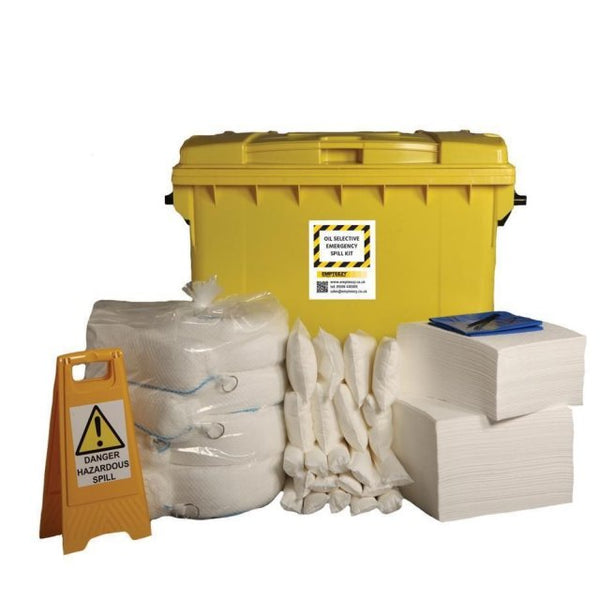
Oil-only pads and socks or booms, loose absorbent, a drain cover or sealing mat, disposal bags with ties, gloves and eye protection, and a written response procedure.
For sites near water, a floating boom is worth adding — containing a spill on the surface is far easier than recovering it once it has spread.
Do oil-only absorbents work on all oils?
They work well on fuels, engine oils, hydraulic oils and most lubricants. Very heavy or cold, viscous oils absorb more slowly, and some synthetic fluids behave differently.
For unusual fluids, check the safety data sheet and the absorbent manufacturer's compatibility guidance rather than assuming.
How much absorbent capacity do I need?
Size against the largest realistic single release — usually the biggest container, drum or delivery hose volume on site, not total storage. Absorbent capacity is stated per kit and is worth checking against that figure.
Distributing several smaller kits near the risks generally beats one large central kit, because response speed matters more than total capacity.
How is used oil absorbent disposed of?
As hazardous waste, in sealed and labelled containers, collected by a licensed carrier with a consignment note retained.
Squeezing or wringing absorbents to reuse them is not appropriate for oil spill response and creates a secondary handling risk.